Knights of Doom Revealed: Doom, Magneto, Green Goblin & Carnage
The Knights of Doom villain team in MARVEL Tōkon features Doctor Doom, Magneto, Green Goblin, and Carnage — here's everything we know about them.
Doom Brought Friends, and They’re Terrifying
The villain team we’ve all been theorycrafting about has a name, a roster, and a trailer that goes absurdly hard. The Knights of Doom are the primary villain faction in MARVEL Tōkon: Fighting Souls, revealed in full during the State of Play 2026 showcase and given their own dedicated trailer that dropped shortly after. The lineup: Doctor Doom, Magneto, Green Goblin, and Carnage.
Four villains. Four distinct playstyles. One shared purpose that ties directly into Episode Mode’s storyline involving the Champion of the Universe. Let’s break down each member, what their gameplay looks like, and why this team composition is generating so much discussion in the fighting game community.
Doctor Doom — The Architect
Starting with the leader, because of course you start with Doom. Doctor Doom is classified as a technical archetype with hard execution difficulty, and from the trailer footage, that classification is dead accurate. This isn’t the Doom from Marvel vs. Capcom 3, where you could win neutral with Hidden Missiles assist and a few good reads. Tōkon’s Doom looks like he requires genuine lab time to pilot effectively.
His toolkit appears to revolve around screen control and trap placement. The trailer showed him deploying energy constructs — glowing green geometric shapes that linger on screen and restrict opponent movement. Think of Bedman? from Guilty Gear Strive, but with more deliberate pacing and a regal aesthetic that screams “I am superior and my frame data proves it.”
What really caught my eye was a sequence where Doom placed two traps, tagged out, and then called an assist that triggered both traps simultaneously while the point character applied pressure. If that’s how his assist works — a delayed multi-trap detonation — he’s going to be one of the most sought-after support characters in the game, even if his point gameplay demands precision.
Doom’s super appears to be a full-screen energy column that starts from a throne animation. I’ve watched it fifteen times. It doesn’t get old. The man sits down on a conjured throne, raises one finger, and the entire stage detonates. Whether it’s practical in competitive play depends on startup frames, but as a style statement? Unmatched.
Magneto — The Aerial Tyrant
Magneto is a zoner with hard difficulty, and his gameplay philosophy appears to center on controlling the vertical space that most characters can’t contest. His magnetic flight state — visible in multiple trailer clips — lets him hover at various heights and attack from angles that ground-based characters simply can’t match.
The flight mechanics look reminiscent of his MvC2 incarnation but modernized for a system with Drive Movement dashes. He can cancel flight into dashes, dashes into flight, and chain aerial normals while floating in ways that seem designed to make anti-air options feel inadequate. If you’re playing a grounded character against Magneto, I suspect the game plan is going to revolve around Wall Breaks — using stage transitions to reset positioning rather than trying to contest his air superiority directly.
His magnetic pull mechanic is the standout detail. Several trailer clips showed Magneto gesture toward an opponent and drag them along the ground toward him, similar to a command grab but at range. It looked like a mid-range tool rather than a full-screen move, and it seemed to pull the opponent into a combo starter. For a zoner, having a tool that forcibly eliminates space is unusual and powerful — it means you can’t simply wait Magneto out at mid-range. He’ll pull you in if you’re passive, and zone you out if you’re aggressive.
Paired with Doom’s traps, Magneto’s pull creates a nightmarish scenario for opponents. Get pulled into a Doom trap? Eat a combo. Try to jump over the trap? Magneto’s flight normals catch you. It’s the kind of team synergy that makes tag fighters sing.
Green Goblin — The Setplay Gremlin
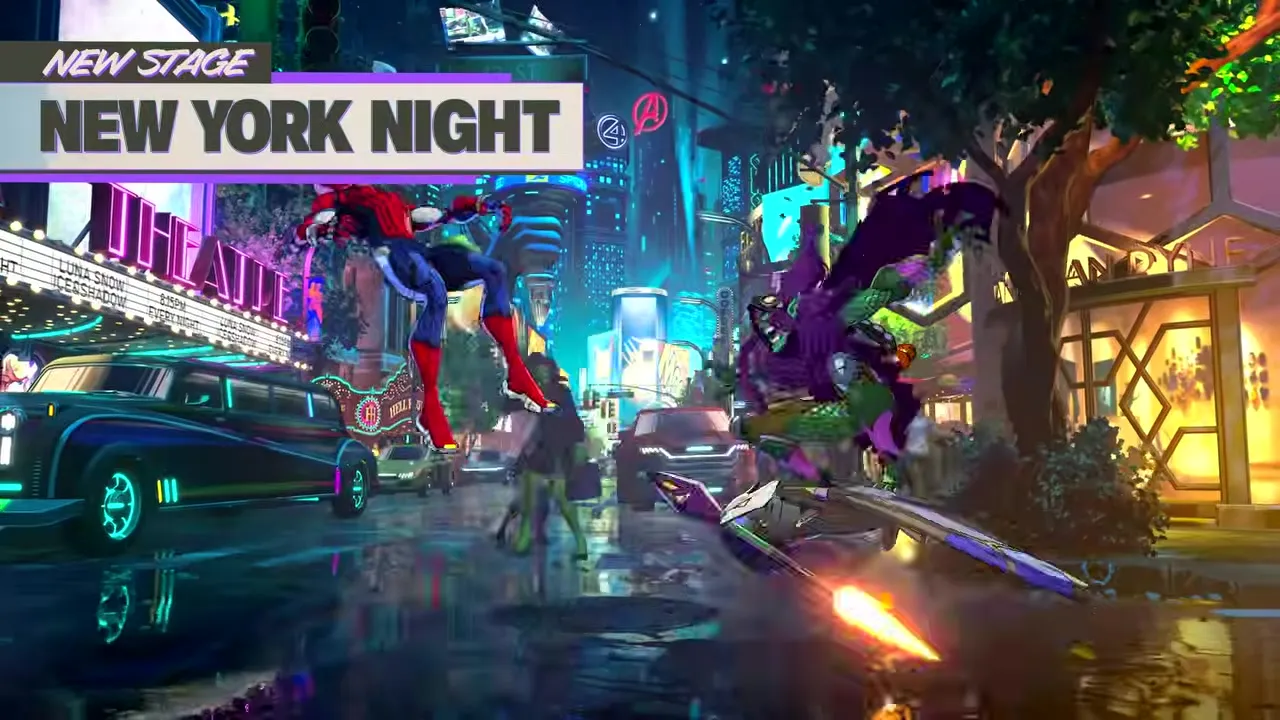
I need to talk about Green Goblin because his design is the most visually creative thing in the roster so far. He fights from the glider. Not sometimes, not as a special move — his neutral stance has him hovering on the Goblin Glider, and his movement, normals, and specials are all built around that aerial platform.
Classified as a technical archetype with hard difficulty, Green Goblin looks like a setplay character in the tradition of fighting game gremlins who make their opponents guess wrong repeatedly. His pumpkin bombs appear to have different properties based on trajectory — some bounced along the ground, some arced overhead, and at least one seemed to track the opponent’s position. Combine that with glider-based mobility that lets him reposition constantly, and you’ve got a character whose gameplan is about creating situations where every option the opponent picks is wrong.
The trailer showed a sequence that’s been replayed constantly in FGC circles: Green Goblin drops three pumpkin bombs in a spread pattern, dashes over the opponent’s head on the glider, and attacks from behind just as the bombs converge from the front. It’s a sandwich setup — you’re forced to block one direction while being attacked from the other. Classic setplay, but the glider mobility makes the mixup timing harder to predict than a traditional crossup.
His difficulty rating of “hard” is going to keep casual players away, which is a shame because he looks incredibly fun. But for the lab monsters out there who live for elaborate setups and unblockable-looking sequences? Green Goblin might be the most rewarding character on the roster.
Carnage — The Berserker
And then there’s Carnage, who is just violence personified. Rushdown archetype, medium difficulty, and from the footage, he plays exactly like you’d want a symbiote berserker to play — constant forward pressure, tendrils extending his range beyond what his frame would suggest, and a sense of controlled chaos in every string.
Where the other Knights of Doom have complex gameplans that require setup and patience, Carnage just goes. His normals look disjointed — the symbiote tendrils extending his hitboxes well beyond his body, similar to how Zato-1 uses Eddie in Guilty Gear but without the puppet management. His pressure strings looked relentless in the trailer, with frame traps that kept the opponent blocking and tick throws that punished them for blocking too much.
The medium difficulty rating is notable. In a team full of hard-execution characters, Carnage is the accessible member — the one you pick if you want to run the Knights of Doom aesthetic but don’t want to spend forty hours in training mode before you can play neutral. That’s a smart design choice. It gives the team a low barrier-to-entry character without compromising the depth of the other three.
Carnage’s super was the trailer’s most visceral moment. The symbiote explodes outward in every direction, filling the screen with red and black tendrils that trap the opponent in a web of violence before a final overhead slam. It looked like it might have invincible startup, making it a reversal option — which would give Carnage both offensive pressure and a way out of the opponent’s pressure, making him extremely well-rounded for a rushdown character.
Team Synergy and the 4v4 Format
Here’s where the Knights of Doom get really interesting. In the 4v4 tag system, you unlock additional team members as the match progresses. Running all four Knights means you’re building toward a late-game team composition where Doom’s traps, Magneto’s pull, Green Goblin’s setplay, and Carnage’s pressure all work together.
The progression matters. If you start Carnage on point — the easiest to pilot, the most immediately aggressive — he can rack up early damage to unlock Doom as your second character. Doom sets traps while Carnage continues pressuring, creating a mid-game shell that’s oppressive. Hit a Wall Break, unlock Magneto as your third, and now you’ve got aerial coverage plus ground control. Finally, Green Goblin comes in as the fourth character to add the most complex layer of setplay once the match has opened up and there’s more screen space to work with.
That’s theorycraft, obviously. We won’t know optimal team orders until the game is in our hands. But the fact that we can even have this conversation — that team building involves not just character choice but unlock sequencing — shows how much strategic depth the tag system adds.
Their Role in Episode Mode
The Knights of Doom aren’t just a competitive team — they’re a narrative unit. In Episode Mode, Doctor Doom has assembled this specific group to address the threat posed by the Champion of the Universe. Whether that means fighting against the Champion or leveraging the chaos for Doom’s own agenda is the central dramatic question of the villain arc.
Each member brings something thematic to the story. Doom is the strategist. Magneto is the reluctant ally with his own ideology. Green Goblin is the wildcard who’s in it for the chaos. Carnage is the weapon — point him at a target and let the symbiote do its thing. It’s a well-constructed villain ensemble that mirrors the kind of uneasy alliances that make Marvel team-ups compelling in the comics.
The fact that all four were revealed simultaneously, as a unit, rather than drip-fed individually tells me they’re meant to be experienced together both in gameplay and in story. If Episode Mode has a Knights of Doom campaign arc — and I’d be genuinely surprised if it doesn’t — that could be the most interesting part of the single-player experience.
The FGC Reaction
The competitive community’s response has been split in a predictable and exciting way. Doom and Magneto are attracting the execution-heavy players who live for optimal combos and setups. Green Goblin is pulling in the weird-character specialists who always gravitate toward the most unconventional member of any roster. And Carnage is the people’s champion — accessible, aggressive, and visually spectacular.
Early tier speculation is meaningless at this stage, but the conversation is already happening. Head over to our tier list page once it’s live for data-driven analysis, and check the confirmed roster tracker for the full lineup as it stands. If you’re new to the game and overwhelmed by the character options, the beginner’s guide will help you narrow down who to start with based on your preferred playstyle.
The Knights of Doom are here. They’re terrifying. And in about seven weeks, we all get to take them for a spin.