Loki
Trickster Illusionist
Loki guide for MARVEL Tōkon: Fighting Souls. God of Mischief trickery, illusion mix-ups, and Samurai Outriders tag strategy.
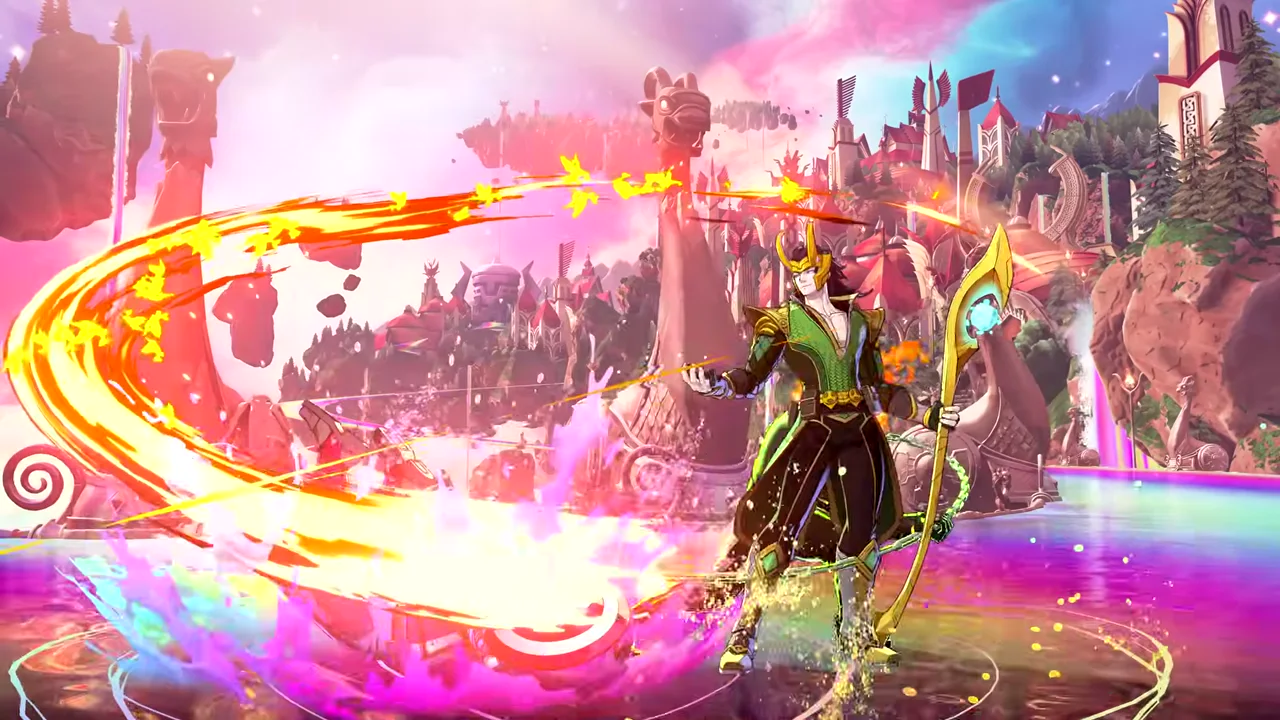
You saw exactly what I wanted you to see. That's the whole trick.
Who Is Loki in MARVEL Tōkon: Fighting Souls?
Of the three Samurai Outriders revealed at Evo 2026, Loki is the one I expect to generate the most theory-crafting discourse before launch, because his entire identity is built around not being what he appears to be. He’s Thor’s adoptive Asgardian brother, God of Mischief, and — per the framing Arc System Works is using — a character actively working through redemption rather than just playing pure villain. That’s a meaningful choice for a fighting game archetype: he’s not evil-coded chaos for chaos’s sake, he’s a trickster who’s trying, however unevenly, to be a hero.
Mechanically, that redemption arc translates into a playstyle built on feints, counters, illusions, and erratic movement, backed up by ice and magic projectiles. It’s a lot of tools stacked on one character, and that’s exactly why he’s landing as the most technical fighter in this new team. Compare him to someone straightforward like Captain America — Loki is the opposite design philosophy, a kit where half the threat is the opponent not knowing what’s real.
Playstyle and Archetype
Loki is a technical archetype, and the confirmed catch to his kit is the important part: he’s vulnerable once the opponent reads through his tricks. That’s a genuinely interesting risk-reward structure for a fighting game character. Most trickster-type fighters either have a gimmick that’s strong until people learn it, or they have consistently strong fundamentals underneath the gimmick. Loki sounds like the former, pushed to an extreme — his illusions and feints are probably very strong against players seeing him for the first time, and considerably weaker against someone who’s drilled his tells.
That makes him a phenomenal counter-pick in blind matches and a genuine execution and mental gymnastics test in the mirror or against prepared opponents. His hard difficulty rating almost certainly comes from this exact tension: knowing when to actually commit to an illusion-based mix-up versus when your opponent has started reading you, and pivoting your gameplan mid-set accordingly.
The ice and magic projectiles give him a zoning layer underneath all the trickery, which matters because a pure mix-up character with no fallback plan gets steamrolled by patient opponents. Expect the projectiles to control space at a range where his feints and erratic movement can then close the distance unpredictably — probably slower startup than a dedicated zoner like Storm, but with enough variety (ice for control, magic bolts for chip or combo extension) to keep opponents honest.
Signature Moves (Expected)
Nothing here is frame-data confirmed — this is informed speculation drawn from the trailer’s description of his kit and his established Marvel identity.
Illusory Feint (expected) — A move where Loki appears to commit to an attack, then either cancels, teleports, or swaps with a decoy. This is probably the backbone of his mix-up game and the source of a lot of his “vulnerable once read” risk.
Frost Bolt (expected) — An ice-based projectile, likely his primary space-control tool. Could carry a slow or freeze property given the ice theming, which would synergize nicely with follow-up mix-ups.
Mirror Image (expected) — A conjured double that either attacks from an unexpected angle or baits the opponent into blocking the wrong side. This feels like the signature “illusion” tool the reveal is teasing.
Erratic Step (expected) — A short, unpredictable teleport or dash used defensively or to reposition mid-neutral. Probably his answer to being cornered, since a pure mix-up character needs an escape option.
Chaos Unbound (Super, expected) — Based on how the super meter tends to work for this roster, I’d guess his level-1 combines multiple illusions or magic bolts into a single hard-to-block sequence.
God of Mischief (expected Level-3) — A cinematic super where Loki’s illusions overwhelm the opponent completely before the real strike lands. This is the kind of “gotcha” moment ArcSys loves staging in their cutscene supers.
Tag and Assist Synergy
An Illusory Double assist would be exactly the tool a technical trickster wants to lend a teammate — a conjured decoy that either extends a blockstring or creates a genuine 50/50 alongside the point character’s own offense. If Loki’s assist carries any of his mix-up DNA, he becomes a premium partner for characters who otherwise have a linear, easy-to-block approach.
On point, Loki wants to establish his ice projectiles early to condition the opponent into respecting range, then start layering in feints once they’re hesitant to just walk forward. In the tag system, he’s probably best used to open a match cautiously rather than as a chaotic first pick — let the trickery work on an opponent who hasn’t seen your patterns yet, then tag to a more straightforward closer once they’ve adapted.
His Wall-Break potential looks medium. Loki’s damage likely comes from successful mix-up reads rather than raw normal damage, so his wall-carry probably depends on stringing together illusion-based openings rather than brute-forcing it the way Ghost Rider can.
Who to Pair Them With
Ghost Rider — The Samurai Outriders’ power anchor. Loki’s illusions create openings; Ghost Rider’s chain-range combos turn those openings into massive damage. A classic “someone opens the door, someone else kicks it in” pairing.
Blade — Loki’s trickery keeps opponents second-guessing their spacing, which sets up Blade’s Heartstopper reads beautifully. Between the two, opponents are never sure whether they’re about to get pinned or mixed up.
Deadpool — Two characters who thrive on unpredictability, just from different angles — Loki through illusion, Deadpool through sheer chaos. Together they’re exhausting to play against. Check the confirmed roster for how the full Samurai Outriders lineup compares to the other launch teams.
Tips for Beginners
Resist the urge to lean on every illusion tool the moment you unlock it — Loki’s kit is deep enough that trying to use everything at once will just get you punished by anyone paying attention. Start with his ice projectile to control neutral and get comfortable with basic spacing before layering in feints. Since he’s rated hard, don’t be discouraged if your first sessions with him feel inconsistent; his entire design assumes a learning curve, both for you and for whoever you’re playing against.
Tips for Competitive Players
The matchup-critical question once frame data lands is exactly how punishable Loki is when his illusions get read — that number defines whether he’s a legitimate top-tier pick or a strong counter-pick who fades in longer sets. Lab his feint’s recovery frames obsessively, because in a mirror or a rematch, opponents will start blocking on reaction rather than reacting to the illusion itself. Also worth exploring: how his Illusory Double assist interacts with the tag system to create legitimate unreactable mix-ups, since that’s likely where his real competitive ceiling lives rather than in his solo neutral game.
A themed splash image for Loki renders automatically above this page.